Best before is about quality; use by is about safety. Food past its best-before date is usually still fine to eat if you stored it properly. Food past its use-by date shouldn't be eaten, even if it looks and smells fine, unless you froze or cooked it on or before the date.
That's the rule in the UK and the EU, where both phrases are defined in law. The US is looser: under federal rules, dates are voluntary on everything except infant formula, and federal guidance treats even "use by" as a quality date. Same words, different rules. Here's how to read both.
| Best before | Use by | |
|---|---|---|
| What it tells you | When quality may start to drop | When the food is no longer safe to eat (UK and EU) |
| Typical foods | Pasta, rice, canned and frozen food, hard cheese, cookies, chips | Fresh meat and fish, ready meals, salads, soft cheese |
| After the date | Usually safe. Check it first | Don't eat it, unless you froze or cooked it in time |
| Can you trust your senses? | Yes, for quality | No. Unsafe food can look and smell normal |
| Can you freeze it? | Yes, any time while it's still good | Only on or before the date |
"Use by" doesn't mean the same thing in the US and the UK
The labels look identical on both sides of the Atlantic, but the rules behind them aren't.
| Label | UK and EU | US (federal) |
|---|---|---|
| Use by | Safety date, required on highly perishable food. After it, the food is legally deemed unsafe | Last date for peak quality. A safety date only on infant formula |
| Best before, best by | Quality date | Quality date. The USDA suggests "Best if Used By" |
| Sell by | Advised against since 2011 | Allowed. A stock-control date for the store |
| Date required? | Yes, on most prepacked food | Only on infant formula |
In the UK and EU, Article 24 of Regulation (EU) No 1169/2011 says highly perishable foods must carry a use-by date instead of a best-before date, and after it they "shall be deemed to be unsafe". The UK kept the rule after Brexit (EUR-Lex, legislation.gov.uk).
In the US, the USDA puts it plainly: "Except for infant formula, product dating is not required by Federal regulations" (USDA FSIS). When a manufacturer does print a date, it describes quality, and that includes "use by". Most states do require dates on at least some products, so you'll still see plenty of them (FLPC).
California is the exception inside the US. Its AB 660 law doesn't require a date, but if food manufactured on or after July 1, 2026 carries one, it must say "BEST if Used by" (or "BEST if Used or Frozen by") for quality and "USE by" (or "USE by or Freeze by") for safety. Consumer-facing "sell by" dates are banned. Infant formula, eggs, and beer and other malt beverages are exempt (CDFA, AB 660 text).
Which rule should you follow? On anything perishable, the strictest one. Even where "use by" is officially a quality date, raw chicken and ground meat only keep 1–2 days in the fridge (FoodSafety.gov). The printed date doesn't change how fast bacteria grow.
Will the US standardize date labels?
Not yet. In December 2024 the FDA and USDA asked the public how date labels should work, and the comment period closed on March 5, 2025. In announcing it, the FDA cited an estimate that confusion over date labels accounts for about 20% of food waste in the home (FDA). As of October 2026 no federal rule has followed. A Harvard Food Law and Policy Clinic review in November 2025 found the agencies still weighing the comments (FLPC). A federal bill, the Food Date Labeling Act of 2025 (H.R. 4987), was introduced in August 2025 and referred to committee (GovInfo).
Every food date label, explained
What each phrase on a pack means, and what to do once the date has passed.
| Label | Meaning | After it |
|---|---|---|
| Best before / best before end | Best quality until this date, if stored as the label says. "End" is used when only a month or year is shown | Usually safe. Check for mold, staleness or a sour smell |
| Best by / best if used by | US wording for the same quality date | Fine if there are no signs of spoilage |
| Use by | The last day to eat the food | UK/EU: don't eat it unless you froze or cooked it by the date. US: a hard limit on infant formula; treat it as one on other fresh food |
| Sell by | How long the store should display it | Still usable. Go by normal fridge times |
| Display until | A stock-rotation date for UK shop staff | Ignore it. Go by the use-by or best-before date |
| Freeze by | Freeze before this date to keep peak quality | Freeze in time. Missed it? Use the fridge time for that food |
| Frozen on | When meat or raw fish was first frozen (required in the UK and EU) | Not a deadline |
| Packed on / pack date | When the food was packed | Not a deadline. Use it to judge freshness |
| Expiration date / EXP | A catch-all with no single legal meaning for food | On perishable food, treat it like a use-by date |
Best before (and best by): the quality date
You'll find best-before dates on lower-risk food: pasta, rice, canned goods, crackers, frozen food, oils and most condiments. In the US the same idea usually reads "best by" or "best if used by". It's the manufacturer's estimate of how long the food stays at its best, as long as you store it the way the label says.
Past the date, use your judgment. The UK government suggests three quick checks: look for mold on bread, taste cookies or chips (biscuits or crisps, in UK terms) to see if they've gone stale, and smell dairy products with a best-before date to see if they've soured (GOV.UK).
Whatever the date says, don't use cans that are swollen, leaking or badly dented.
One exception: eggs. In the UK, eggs carry a best-before date no more than 28 days after they were laid. Food Standards Scotland says you can eat them a day or two after that date, but only if you cook them thoroughly, for example hard-boiled or in a cake (FSS).
Use by: the safety date
Use-by dates go on perishable, higher-risk food: fresh meat and poultry, fish, ready meals, soft cheese and prepared salads. In these foods harmful bacteria can grow without changing how the food looks, smells or tastes. The UK government is blunt: eating food after the use-by date could make you ill (GOV.UK).
That's why your nose doesn't help here. Food Standards Scotland says the smell test is fine for best-before food, but not for use-by food (FSS).
Freeze it or cook it before the date
A use-by date really means "eat, cook or freeze by". Per GOV.UK's guidance:
- Freeze it on or before the use-by date. It won't deteriorate in a freezer at −18°C (0°F). Once you defrost it, eat it within 24 hours.
- Cook it on or before the use-by date. Then eat it within 48 hours, or freeze it.
- Keep chilled food chilled. UK guidance says 5°C or below; US guidance says 40°F (4°C) or below (FoodSafety.gov). Food stored too warm can become unsafe before its use-by date.
"Once opened" beats the printed date
Many packs add a line like "Once opened, eat within 2 days." Follow it. Food Standards Scotland points out that these foods go off quickly once opened (FSS). The printed date assumes a sealed pack, so an opened one can spoil well before it.
US fridge charts work the same way. FoodSafety.gov gives luncheon meat 2 weeks unopened but 3–5 days once opened or deli-sliced, and hot dogs 2 weeks unopened but 1 week once opened (FoodSafety.gov).
The easy fix: write the day you opened it on the pack. Whichever date comes first, the "once opened" deadline or the printed one, is the one that counts.
Sell by, display until and other store dates
- Sell by tells the store how long to display a product. The USDA is clear it isn't a safety date (USDA FSIS). Food is usually fine for a while after it, but raw meat and fish still follow their short fridge times.
- Display until is the UK equivalent for shop staff. In 2011 the UK government asked retailers to drop both "sell by" and "display until" marks to stop confusing shoppers, though you may still spot them (Defra).
- Lot, batch and can codes identify when and where something was made. The USDA says can codes aren't meant for consumers to read as a best-by date. They're useful for checking recalls.
Infant formula: the one date the US requires
Infant formula is the only food that US federal rules require to carry a date. Under FDA regulations, the label must show a "Use by" date, set by the manufacturer from testing, up to which the formula still contains the nutrients listed and stays usable (21 CFR 107.20). It's a firm limit. The USDA's advice: don't buy or use infant formula after its use-by date.
How to read a food date label
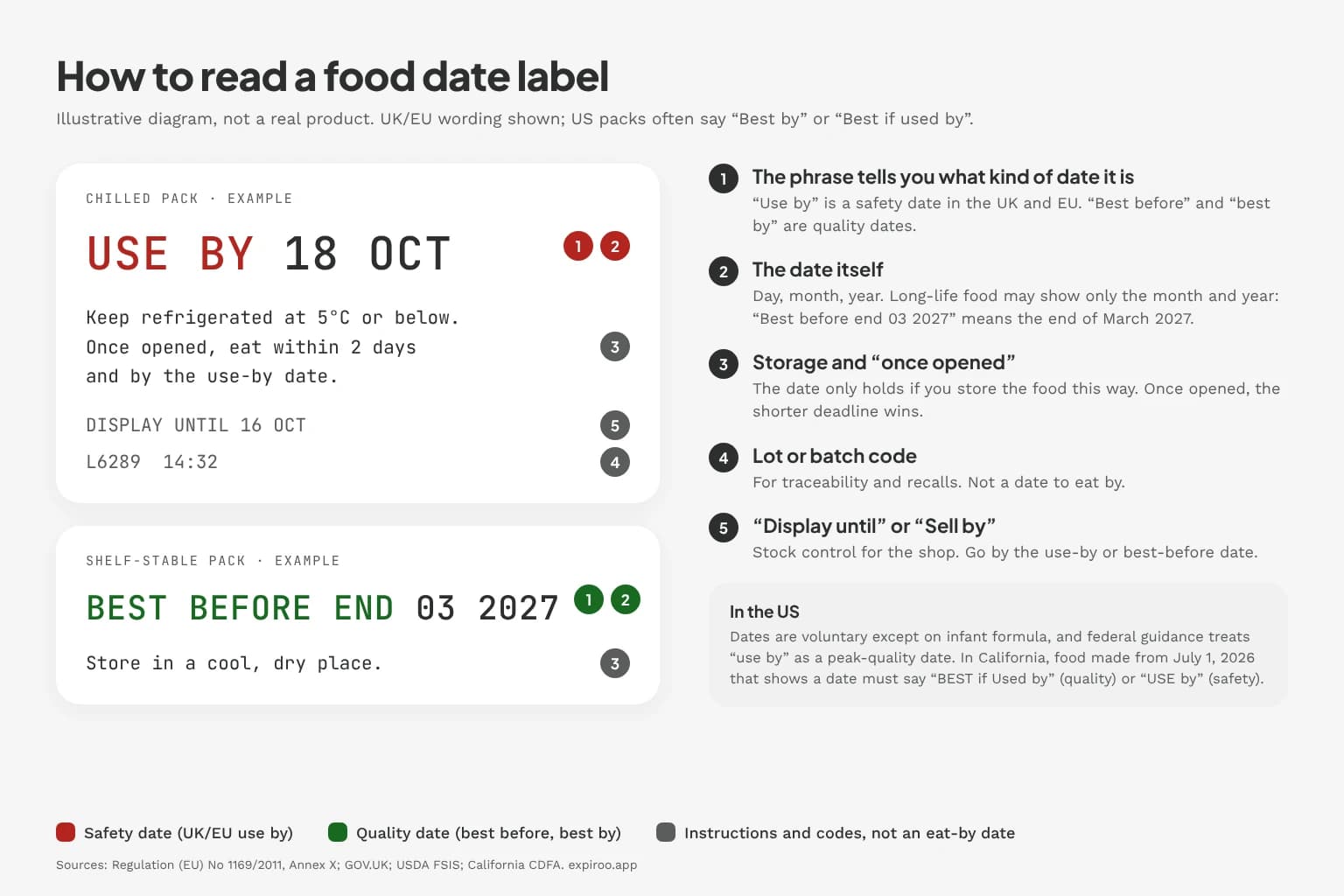
Illustrative diagram, not a real product.
- Find the date. Look on the front, the lid, the base of a can or the side of a carton. UK and EU labels may point you elsewhere, such as "Best before: see lid".
- Read the phrase in front of it. The words decide which rules apply: "use by" is the safety date in the UK and EU; "best before", "best by" and "best if used by" are quality dates; "sell by" and "display until" are for the shop.
- Decode the format. UK and EU dates run day, month, year and are never coded. Food that keeps up to three months can show just the day and month, food that keeps 3–18 months the month and year, and longer-life food the year alone. So "Best before end 03 2027" means the end of March 2027 (legislation.gov.uk). The US has no single format, and 10/12/26 means October 12 in the US but 10 December in the UK. Check where an imported product came from.
- Ignore codes that aren't dates. Lot and can codes are for the supply chain. On USDA-graded egg cartons, the pack date is a three-digit day of the year, from 001 for January 1 to 365 for December 31 (USDA FSIS).
- Read the storage line next to the date. The date only holds if you follow it, including any "once opened" instruction.
Foods with no date at all (and why your apples lost theirs)
Not everything needs a date. In the UK and EU, best-before dates aren't required on uncut fresh fruit and vegetables, wine, drinks with 10% or more alcohol, bakery goods normally eaten within 24 hours, vinegar, cooking salt, solid sugar, sugar confectionery and chewing gum (legislation.gov.uk).
If your supermarket apples stopped carrying a date, that's on purpose. Since 2019 the waste charity WRAP has advised UK retailers to drop best-before dates from uncut fresh produce, because shoppers throw out good fruit and veg once the date passes (WRAP). Tesco started in 2018, and M&S, Sainsbury's, Asda and Waitrose removed them from hundreds of lines in 2022 (MoneySavingExpert). Co-op followed in 2023 (Co-op News). Judge produce by eye and touch: soft spots, mold and smell tell you more than a printed date did.
When it's safe to eat past the date
A simple rule of thumb:
- Shelf-stable food past its best-before date: usually fine. Check it and trust your senses.
- Perishable food past its use-by date: don't eat it. This is the line you don't cross.
- Food you froze or cooked before its use-by date: fine, within the windows above.
- Infant formula past its use-by date: never.
In the US, where most dates describe quality, fridge times are the better guide for perishables. A few from the FoodSafety.gov chart, for a fridge at 40°F (4°C) or below:
| Food | Fridge time |
|---|---|
| Raw chicken or turkey | 1–2 days |
| Raw ground meat | 1–2 days |
| Raw steaks, chops and roasts | 3–5 days |
| Raw eggs in the shell | 3–5 weeks |
| Luncheon meat | 2 weeks unopened, 3–5 days opened |
The full list, from seafood to leftovers, is in our guide to how long food lasts in the fridge.
Spoilage signs work in one direction only. An off smell, flavor or texture means the food has spoiled, but no smell doesn't mean a use-by food is safe. And the USDA notes that a change in the color of meat or poultry isn't, on its own, a sign of spoilage (USDA FSIS).
General information, not health advice. Respect every use-by date: the risk after it can't be seen, smelled or tasted. Best-before food can be judged on quality, but when in doubt, throw it out. Always follow the storage instructions on the pack.
A simple routine so dates stop sneaking up on you
Most food waste happens at home. The UN Environment Programme estimates households produced 60% of the 1.05 billion tonnes of food wasted in 2022 (UNEP Food Waste Index Report 2024). Date labels are part of it: the European Commission estimates up to 10% of the food waste generated in the EU each year is linked to date marking (European Commission).
A few habits fix most of it:
- Track the date that matters. That's the use-by date on chilled food and the best-before date on pantry staples. Ignore sell-by and display-until.
- First in, first out. When you unpack the shopping, move older items to the front of the fridge and cupboard.
- Freeze before the date, not after. If you won't get to something in time, freeze it while it's still good.
- Note when you open things. The "once opened" clock is the one people forget.
The hard part is remembering all of it. Expiroo keeps the list for you: add an item (scan the barcode to fill it in fast) and it reminds you 7, 3 and 1 days before the date, and again on the day. It works offline with no account. It's in closed beta on Google Play — here's how to join.
Frequently asked questions
What's the difference between best before and use by?
Best before is about quality: after it, food may lose flavor or texture but is usually still safe if it was stored properly. Use by is about safety: in the UK and EU, don't eat food after its use-by date, even if it looks and smells fine, unless you froze or cooked it on or before the date.
Can you eat food the day after its use-by date?
In the UK and EU, no. The date is the safety limit, and food can be unsafe without looking or smelling off. The exception is food you froze or cooked on or before the date. In the US, "use by" is officially a quality date, but perishables like raw chicken still keep only 1–2 days in the fridge, so treat it as the limit.
Can you eat food after the best-before date?
Usually, yes. Check it first: look for mold, taste dry food for staleness and smell dairy for sourness. Don't use swollen or leaking cans. Eggs are the exception: in the UK, eat them no more than a day or two past the date, and only if cooked thoroughly.
Is "best by" the same as "best before"?
Yes. Both are quality dates. "Best by" and "best if used by" are the usual US wording; "best before" is the UK and EU wording.
Is "use by" the same as an expiration date?
Not exactly. UK and EU law uses "use by" for safety and doesn't define an expiration date. In the US, "EXP" has no single legal meaning for food. On perishable food, the cautious move is to treat any expiration date like a use-by date.
What does "sell by" mean?
It tells the store how long to display a product. It's for stock control, not safety. California bans consumer-facing "sell by" dates on food made on or after July 1, 2026.
Can you freeze food on its use-by date?
Yes, as long as you freeze it on or before the date, never after. Keep the freezer at −18°C (0°F) and eat the food within 24 hours of defrosting.
Why don't fruit and vegetables have best-before dates anymore?
Because the dates made people throw away good produce. UK supermarkets have been removing them from uncut fruit and veg since 2018, and WRAP has recommended it since 2019. Judge produce by how it looks, feels and smells.
Sources
Checked on October 16, 2026.
- USDA Food Safety and Inspection Service, Food Product Dating
- Electronic Code of Federal Regulations, 21 CFR 107.20 (infant formula "Use by" date)
- FoodSafety.gov, Cold Food Storage Charts (last reviewed September 19, 2023)
- U.S. Food and Drug Administration, USDA-FDA Seek Information About Food Date Labeling (December 3, 2024)
- Harvard Food Law and Policy Clinic, Review of food date labeling RFI responses (November 2025)
- U.S. Congress, H.R. 4987, Food Date Labeling Act of 2025 (as introduced)
- California Department of Food and Agriculture, Food Date Labeling, and AB 660, chaptered text
- GOV.UK, Best before and use-by dates (Food Standards Agency guidance)
- Food Standards Scotland, Use-by and best-before dates and Food storage
- Defra, Expiry date for confusing date labels (September 15, 2011)
- Regulation (EU) No 1169/2011, Article 24 and Annex X; UK version: Annex X
- WRAP, Labelling guidance: Best practice on food date labelling and storage advice (2019, updated February 2022)
- MoneySavingExpert, Supermarkets scrapping best before dates (July 2022, updated September 2022); Co-op News, Co-op axes best before dates on fresh fruit and veg (February 2023)
- European Commission, Date marking and food waste prevention
- UN Environment Programme, Food Waste Index Report 2024